
Engineering Durability: Manufacturing the Stanley FatMax 20" Tote with Cover

Project Profile
Client: STANLEY (Black & Decker)
Manufacturer: Dingfeng Ibagcase
Service Type: OEM / Contract Manufacturing
Core Materials: 600 Denier Nylon, Polypropylene (PP), Steel
The Engineering Mandate
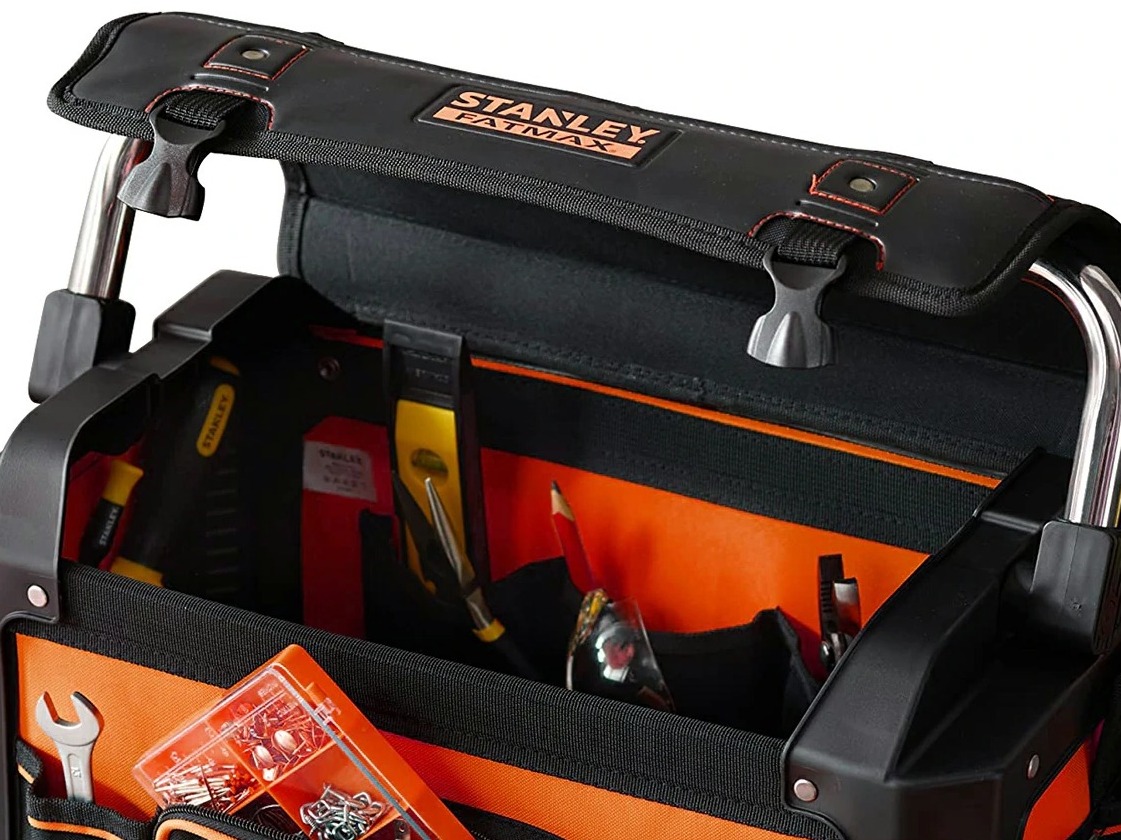
The Stanley FatMax series represents the industry benchmark for professional tool storage. For Dingfeng Ibagcase, the project mandate for the Stanley FatMax Tool Tote was clear: produce a 20-inch hybrid tote that combines the accessibility of an open carrier with the weather resistance of a sealed unit.
The primary challenge was not textile assembly, but material integration.
This product requires bonding a flexible heavy-duty fabric body to a rigid, injection-molded polypropylene chassis—a process where standard manufacturing methods often fail due to needle breakage or seam separation.

Manufacturing Challenges & Technical Solutions
1. The "Hard-Bottom" Integration (Plastic to Fabric)
The Problem:
The waterproof polypropylene base is rigid. Standard sewing machines often overheat when penetrating this density, causing the plastic to melt around the needle (gumming) or the needle to fracture, leading to weak seams that separate under load.
Our Solution:
Tooling: We utilized heavy-gauge computerized programmable sewers equipped with air-cooled diamond-point needles. The "diamond" tip cuts the plastic cleanly rather than piercing it, reducing friction heat.
Thread Specification: We employed Bonded Nylon 6.6 thread (High Tenacity). This thread is chemically bonded to resist fraying against the hard plastic edges, ensuring the base remains waterproof and attached even when the bag carries 25kg+ loads.
2. Structural Steel Handle Reinforcement
The Problem:
The heavy-duty steel handle bears the entire weight of the tote. The connection points between the steel bar and the fabric body are high-stress zones prone to tearing.
Our Solution:
Internal Skeleton: Hidden inside the fabric walls, we inserted PE (Polyethylene) stiffener boards. The steel handle is not just attached to the fabric; it is riveted through the fabric, the webbing, and this internal PE plate.
Load Distribution: This sandwich construction distributes the vertical shear force across a 10cm² area rather than a single stitch line, effectively eliminating tear-outs.
Bar-Tack Stitching: All webbing stress points utilize high-density Bar-Tack stitching (42-stitch cycle) rather than standard box stitching.
3. 600 Denier Material Logic
The Problem:
Construction sites expose bags to concrete, exposed rebar, and sharp tools like chisels and saws.
Our Solution:
Material Sourcing: We selected a specific 600 x 600 Denier Ballistic Nylon with a heavy PVC backing. This provides two functions:
Puncture Resistance: Prevents tools from poking through the pockets.
Structural Memory: The PVC backing adds rigidity, allowing the bag to stay open and upright ("Box Shape") even when empty, as seen in our production samples.


Quality Control (QC) Protocols
At Dingfeng Ibagcase, visual inspection is insufficient for industrial-grade OEM products. We implemented the following batch tests for the Stanley FatMax Tool Tote:
The "Jerk" Test:
The bag is loaded with 30kg and mechanically jerked by the handle 500 times to test rivet integrity.
Drop Test:
A fully loaded unit is dropped from 1 meter onto concrete to ensure the injection-molded base does not crack or shatter.
Corrosion Resistance:
All metal zippers and rivets undergo a 24-hour Salt Spray Test to simulate humid job site conditions.

Summary
The Stanley FatMax Tool Tote stands as a testament to Dingfeng Ibagcase’s ability to handle complex, mixed-material manufacturing. By solving the technical hurdles of plastic-to-fabric adhesion and structural load-bearing, we delivered a product that meets the rigorous demands of global tool brands.
SEND INQUIRY
Featured Products


