Total Cost of Ownership: Why Cheap OEM Bags Cost More in the Long Run
As an OEM bag manufacturer, we receive hundreds of purchase inquiries every year. Many of them start the same way: “Can you match this lower price?” Typically, When someone wants to source products—whether for retail, promotional giveaways, or private label—it’s easy to get hyper-focused on the unit price. However, experienced procurement managers know that the sticker price is just the tip of the iceberg. To understand the true impact on your bottom line, you have to look at the Total Cost of Ownership (TCO).
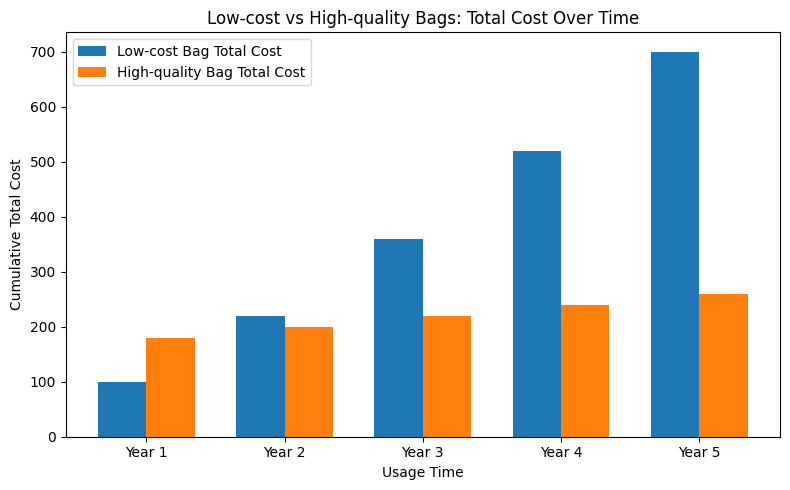
TCO looks beyond the invoice price to capture every dollar tied to owning and using that product: replacement frequency, returns, repairs, brand damage, and lost repeat business. When you run the numbers on low-cost OEM bags, the "cheap" option often turns out to be the most expensive one.
That is why experienced buyers eventually shift their focus from unit price to total cost of ownership.
1. The "Hidden" Bag Manufacturing Cost
When a factory offers a price significantly below the market average, they aren’t performing a miracle—they are making sacrifices. These sacrifices usually happen in places you can’t see until the product is already in your customers' hands.
Substandard Hardware: Cheap alloys that rust or zippers that teeth-split after ten uses.
Structural Shortcuts: Skipping reinforcement stitching at stress points (like shoulder strap attachments).
Material Integrity: Using "filler" materials in PU or low-grade nylon that begins to peel or crack within months.
The Reality: If a bag lasts six months instead of three years, your customer isn't just buying a new bag—they are buying it from your competitor next time.
2. The High Price of Weak OEM Quality Control
Quality control is often the first "expense" a low-cost OEM factory will cut. Without rigorous OEM quality control, you are essentially gambling with your brand’s reputation.
Consider the secondary costs of a high defect rate:
Logistics Nightmares: The cost of shipping defective goods back or disposing of them.
Administrative Drain: The hours your team spends processing returns and managing disgruntled emails.
Refund Losses: Every refund isn't just a lost sale; it’s lost marketing spend and lost shipping costs.
3. Brand Equity: The Cost of a Bad Review
In the digital age, a "cheap" bag leaves a permanent paper trail. One viral video of a strap snapping or a seam bursting can undo years of brand building.
High-quality manufacturing acts as an insurance policy for your marketing budget. When you invest in premium construction, you are buying positive social proof, lower churn rates, and the ability to command a premium retail price.
Comparison: Low-Cost vs. Value-Driven Manufacturing
| Feature | The "Cheap" OEM | High-Quality Partner |
| Initial Unit Cost | Low | Fair/Premium |
| Defect Rate | 5% – 10%+ | < 1% |
| Lifespan | 3–6 Months | 2–5 Years |
| Customer Support | Reactive / Non-existent | Proactive / Partnership |
| Long-term TCO | High (Returns + Lost LTV) | Low (Loyalty + Referrals) |
Choosing a manufacturing partner based solely on the lowest bid is a short-term win that creates a long-term liability. Professional buyers, sourcing managers, and brand owners evaluate suppliers based on total cost of ownership, not just bag manufacturing cost. They understand that strong OEM quality control, stable materials, and experienced production teams are what protect margins in the long run.
Don't pay for the same bag twice through returns and lost customers. Invest in quality the first time.
A Sourcing Manager's Guide to Custom Bag Prototyping: 3 Ways to Speed Up NPI (New Product Introduction)
How We Use GRS-Certified Recycled Fabrics for Heavy-Duty Tool Bags
Related Article