Tensile Strength vs. Tear Resistance: Decoding Fabric Testing Data for Industrial Tool Bags

Although often confused, tensile strength and tear resistance measure different failure behaviors.
Tensile Strength (Breaking Strength): The maximum load a fabric can withstand before it snaps while being pulled from opposite ends. This determines how much weight your bag can carry without the fabric failing.
Tear Resistance: The force required to propagate an existing small nick or cut. This determines how "tough" the bag is when it encounters sharp job-site hazards.
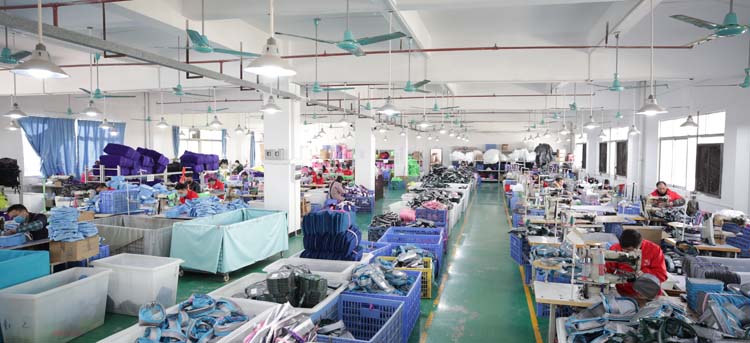
At our testing facility, we subjected the two most common industrial fabrics to standardized ISO and ASTM testing. Here is how they compare:
| Performance Metric | 600D Polyester (Standard) | 1680D Ballistic Polyester (Heavy-Duty) | Performance Increase |
| Tensile Strength (Warp) | ~1,100 N | ~2,800 N | +154% |
| Tensile Strength (Weft) | ~950 N | ~2,450 N | +157% |
| Tear Strength (Tongue Rip) | ~45 N | ~160 N | +255% |
| Puncture Resistance | Moderate | High | Superior |
Note: Data represents average values from 100% polyester PU-coated industrial-grade fabrics.
Expert Quote: A Legacy of Durability
To get a better perspective on how these numbers translate to the real world, we spoke with our production veteran.
“After 28 years of overseeing tool bag manufacturing, I’ve seen many brands choose 600D to save on costs. While 600D is fine for DIY use, professional industrial environments demand the 'safety margin' of 1680D. It’s not just about carrying weight; it’s about the fatigue the fabric suffers over years of being dragged across concrete floors.”
— Mr. Zhang, with 28 years of experience in industrial tool bag manufacturing
Recommended Fabric Selection by Application
| Tool Bag Application | Recommended Fabric |
| Electrician tool bags | 1680D Polyester |
| Automotive repair bags | 1680D Polyester |
| Promotional tool kits | 600D Polyester |
| Household DIY tool bags | 600D Polyester |
For OEM, private label, and industrial wholesale projects, 1680D fabric is strongly recommended in high-stress areas. While 600D is suitable for light-duty or promotional tool bags.
Frequently Asked Questions
Q1: Is a higher denier always better for tool bags?
A: Not necessarily. While higher denier (like 1680D) offers superior strength, it is also heavier and stiffer. For small pouches or internal organizers, 600D is often preferred for its flexibility and weight savings. However, for the main body of a heavy-duty tool bag, 1680D is the industry gold standard.
Q2: Does the coating (PU vs. PVC) affect tensile strength?
A: The coating primarily affects water resistance and "hand feel," but it does provide a slight boost to tear resistance by locking the fibers in place. Polyurethane (PU) is generally preferred for industrial bags as it remains flexible in cold weather compared to PVC.
Q3: How do I know if my bag is actually 1680D?
A: Genuine 1680D has a distinct "basket weave" appearance—two threads crossing over two threads. Low-quality imitations often use a single-weave 900D and label it as 1680D. Always ask for a certified lab report showing the tensile strength data mentioned above.
How We Test the Durability of 4WD Off-road Recovery Bags: A Comprehensive Guide
Heavy-Duty Tool Bag Materials: Why Waterproof Tarpaulin and Rugged Canvas Dominate Industrial Performance
Related Article