Custom Bag Sample Fees Explained: Why Suppliers Charge Them and How They Work

We get this question a lot.
You send over your tech pack, we have a great conversation about your brand, and the mass production price looks perfect. But then, I send you the invoice for the prototype, and there’s a sample fee of $120, $200, or sometimes more.
It’s completely normal to wonder: "Why do you charge a high fee for the sample? It’s just one bag. If I’m going to place a big order later, shouldn’t the sample be free?"
Let me be completely honest with you: factories do not make money on sample fees. In fact, we usually lose money on them. We charge them because making a single custom bag from scratch takes a massive amount of time, energy, and resources.
Here is the reality of what happens on the production floor, and how the sample fee actually works to protect your project.
1. Sourcing Small Material Quantities is Expensive
When you place a bulk order, my team buys fabric directly from the mill by the thousands of yards. We get the lowest wholesale price.
But for a sample? It’s a completely different story. My sourcing manager has to physically drive to the material market, spend 1-2 day finding the exact material and color match, and buy just one or two yards at a highly inflated "retail" price. Even worse, component suppliers often enforce their own Minimum Order Quantities (MOQs). This means we might have to buy a pack of 50 zipper pulls just to use the one your prototype needs. The material waste in the sampling stage is huge.
2. Sample Production Requires Senior Pattern Makers (Not Line Workers)
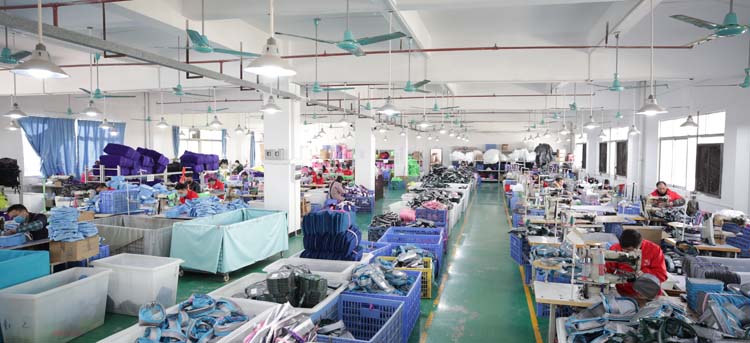
In mass production, speed comes from the assembly line. One worker sews the straps, another does the zippers, all day long. It's fast and efficient.
A sample is entirely different. We can't put one bag on the production line. It is built entirely from scratch by one person: a Master Pattern Maker. This craftsman has to study your 2D design and figure out how to make them work in the real world.
They manually draft the paper patterns, calculate seam allowances, test internal structural supports, cut the fabric by hand, and sew the entire piece together. Depending on the complexity of your custom bag, this process takes anywhere from 7 to 10 working days of highly skilled labor. In fact, the sample fee is completely insufficient to cover their salary for this period of time.
3. Machine Setup and Custom Tooling Costs
Custom details don't just magically appear. If your bag design includes a custom logo or uniquely branded hardware, we have to create physical molds, dies, and printing plates.
Setting up an industrial stamping machine for one single sample takes the exact same amount of time, technical effort, and machine downtime as setting it up for a 1,000-unit run. Pulling a machine off the main production line to test one bag temporarily halts the factory's daily output.
Also, if your design needs a special heavy-duty stitch, we have to stop a machine on the main floor, change the threads, and recalibrate the tension just for your one bag. In manufacturing, machine downtime equals lost money.
4. The "Real Buyer" Filter
As a bag manufacturer, we receive dozens of inquiries every day. Many of them are from hobbyists who just want a single custom bag for personal use, pretending to be a commercial brand to get factory pricing.
Our engineering time is limited. We simply cannot afford to make free bags for everyone who asks. The sample fee acts as a filter. It tells me that you are a serious buyer with a real business, and that we should dedicate our best resources to your project.
The Good News: Sample Fees Are Usually Refundable!
Here is the most important thing you need to know about how we work: I don’t want your sample fee. I want your bulk order. The sample fee isn’t a sunk cost—it’s a deposit.
For serious brands, the sample eventually costs nothing. In our factory, once your bulk order meets our standard MOQ, we deduct the sample fee entirely from your final mass production invoice.
Protect Your Mass Production Investment
Think of the sample phase as cheap insurance. It guarantees that an elite team of experts is dedicating their full attention to perfecting your design before you spend thousands of dollars on a full production run. It ensures your dimensions are right, the materials feel premium, and the structure holds up.
Ready to bring your bag design to life? Send us your tech pack or design ideas today, and let’s build a sample you’ll be proud of.
The Hidden Cost of Standard Packaging: Why Device Brands Are Switching to Custom Cases and Bags
The Strategic Buyer's Guide: Mapping Out Your Q3/Q4 Custom Bag&Case Production in May/June
Related Article